
You can now buy intelligence at a monthly price. The old gatekeepers were credentials, departments, and long apprenticeships. Now you enter your card, choose a tier, and a model reasons for you. The cheapest plans answer simple questions. The expensive ones think longer, draw finer distinctions, and catch what you miss. Intelligence used to sit inside people and institutions. Now it sits on a shelf next to software, metered by the month and graded by the model.
ChatGPT Plus still costs $20 a month. ChatGPT Pro is listed as $100 or $200, depending on usage allowance. Pay per token through an API and dial the list price up or down by picking a model name.
On 14 August 2026, OpenAI's API pricing page listed GPT-5.6 Luna at $0.20 input and $1.20 output per million tokens on the short-context Standard ladder, and GPT-5.6 Sol at $5 input and $30 output. Long-context cells on the same page are higher. They are a separate price. The same day, Anthropic's pricing page listed Haiku 4.5 at $1 input and $5 output, and Fable 5 at $10 input and $50 output. OpenAI's 30 July 2026 post said Luna's list price was cut 80% and Terra's 20% that day, with Sol unchanged and subscription stickers unchanged. Those are list prices, not invoices. Enterprises negotiate. Cache and batch change the bill.
They price it like power
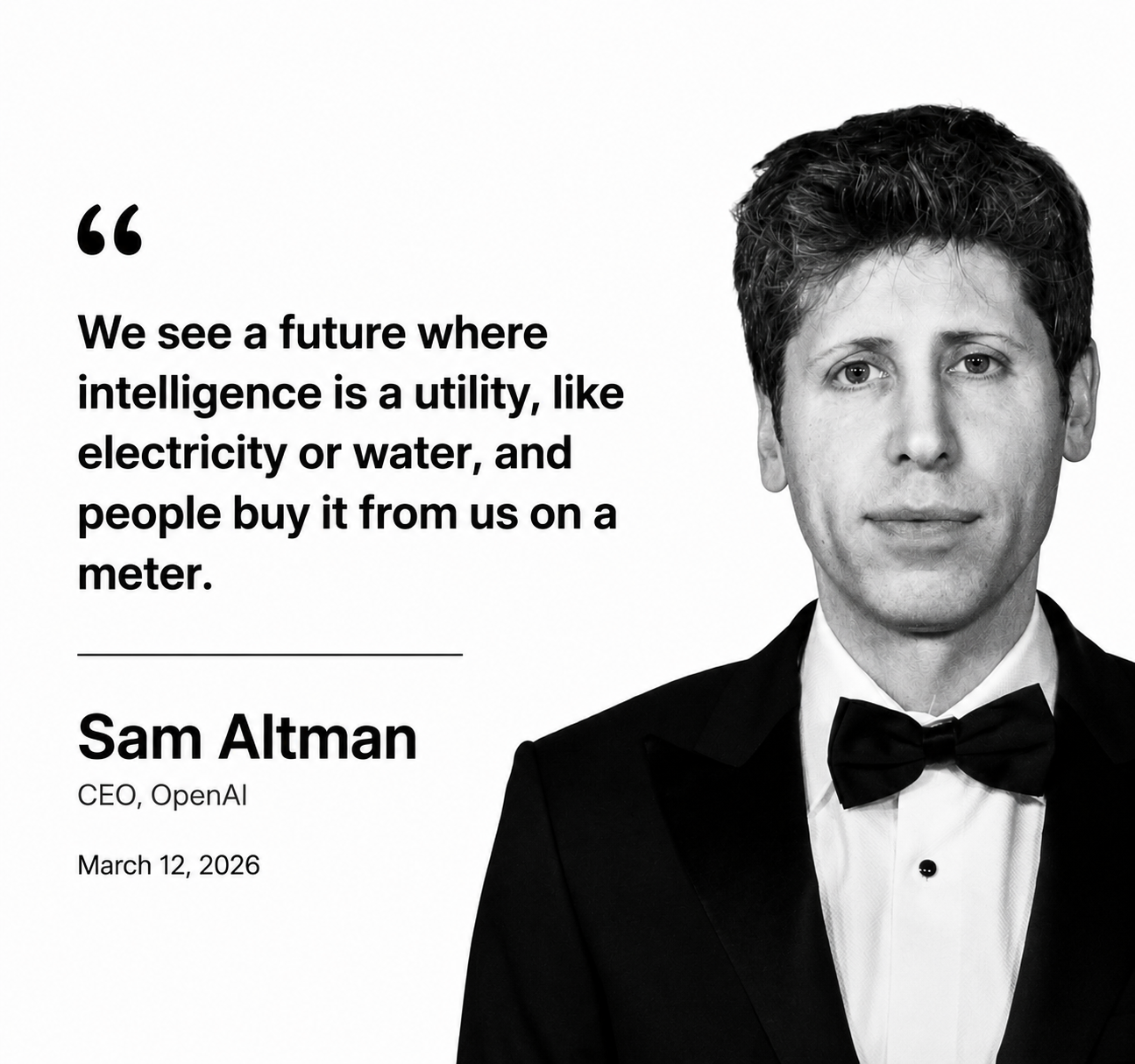
The people running the largest AI labs describe their products as utilities now. Sam Altman, OpenAI's CEO, said at the BlackRock Infrastructure Summit in March 2026, as reported by Business Insider: "We see a future where intelligence is a utility like electricity or water and people buy it from us on a meter and use it for whatever they want to use it for." He added that the business of every model provider "is going to look like selling tokens." A Rev transcript of the same talk has him borrowing the old energy phrase of making intelligence "too cheap to meter."
Andrew Ng called AI "the new electricity" years ago. The former Google Brain and Baidu scientist said that "just as electricity transformed almost everything 100 years ago," AI will transform almost every industry. Satya Nadella frames it as a commodity input. At Davos in January 2026, the Microsoft CEO said, according to CNBC, that "GDP growth in any place will be directly correlated" to energy costs in using AI, and that the job of every economy is to "translate these tokens into economic growth." Jensen Huang, NVIDIA's CEO, calls these facilities AI factories: "In the era of AI, every manufacturer needs two factories: one for making things, and one for creating the intelligence that powers them."
 Tap to enlarge
The cost of better decisions
For most of human history, good judgment was scarce. It came from parents, priests, elders, bosses, lawyers, doctors, analysts, and friends who had seen more than you. Getting their attention cost money, status, or time. The rest of us guessed. We made decisions with partial information and lived with the stress of not knowing if we had chosen well.
A few centuries ago, black pepper and cinnamon were expensive. Kingdoms funded voyages to find them. A cook without spices had few options. Then trade routes opened, prices fell, and kitchens changed. Today, no one brags about having salt. Flavor is cheap. We expect it. The baseline moved.
The same thing is happening to judgment, with a limit. You can buy a second opinion, ask a model to check your reasoning, list risks, compare options, and name what you missed. The model can be wrong. You can ask again. You no longer depend only on the intelligence you happen to know in person. That is cheaper access to a second pass. It is not a specialist, and it is not the end of scarce expertise.
More intelligence costs more. The cheapest models are fast and broad: they answer emails, summarize documents, rewrite code comments, and generate first drafts. They are good enough when being right 9 times out of 10 is acceptable. The stronger models cost more because they use more compute. They think in longer chains and hold up better in math, law, medicine, and strategy, where a wrong answer is expensive.
At the top sits a small class of reasoning models that take longer and cost more, reserved for decisions where the stakes justify the bill. A founder might use the cheap model for customer support and the expensive one for a term-sheet clause. The premium is longer reasoning, better judgment, and lower error rates. You pay for the quality of the thinking, not the existence of the thinking.
Wrong decisions are expensive. They cost money, time, relationships, health, and reputation. The fear of choosing badly produces a kind of tax: people delay, avoid risk, second-guess themselves, or hand decisions to committees to spread blame. The stress of not knowing is itself a cost.
Outsourced intelligence cuts that tax. A sanity check lets you act faster. A simulated consequence lets you take a smarter risk. A structured answer to "what am I missing?" lowers the background noise of doubt. The model will be wrong sometimes. The value is that you no longer decide alone.
A parent can research a symptom without panicking, then still call a doctor when it matters. Tasks that used to require access to someone with more experience now require a subscription. The barrier is lower, so the activity becomes more common. More people make more decisions with more support than before.
 Tap to enlarge
Free advice has always been the most expensive kind. Your uncle gives you stock tips. Your friend recommends a doctor. Your coworker suggests a framework. They mean well, but they are not paid for the outcome. Their incentive is to sound helpful, not to be right. They spend 2 minutes on a choice that will shape your year. You smile, thank them, and carry the risk alone.
Paid intelligence changes the contract. A model does not need to please you and has no reputation to protect in the room. It lists downsides you do not want to hear and asks the follow-up you were avoiding, because you can keep paying, not because it is wise. The meter resets every conversation. You get the patience of a full-time analyst for the cost of a sandwich.
The real cost is attention, not money. You still have to read the answer, check the facts, and act on what it says. Intelligence without action is noise. Noise is easier to filter when the signal is cheap.
 Tap to enlarge
After you have used the tool, a problem that used to take a day of reading now takes an hour. A decision that used to rest on intuition can carry a structured analysis behind it. The person who refuses the tool does not look noble. They look slow.
People who use the tool well will outperform people who do not, the same way spreadsheets replaced ledgers. Then the tool becomes the floor. Skipping it will feel like cooking without salt: possible, but odd.
You do not hire one giant model for everything. You hire a contract reviewer, a coding partner, a writing coach. Some cheap, some expensive. Some plan, some verify, some argue with a second model. The list price is already that menu.
Intelligence is cheap enough to rent. Judgment is not. Models list options and lower the fear of being wrong. They do not pick your values or act in your place. The edge is what to ask, how to check the answer, which model to hire, and when to ignore the machine.