
On 28 March 2025 CoreWeave listed on Nasdaq and called itself "the AI Hyperscaler." Eleven months earlier, its IPO filing said most of its sales came from long contracts where the customer pays even if the machines sit idle. Microsoft was 62% of 2024 sales. A real giant cloud company does not live or die on one customer. This one does.
Sovereign AI debt is about who pays for the building. National compute programmes are about what governments put on a scoreboard. The private firm in the middle owns GPUs, borrowed against those chips, and needs a famous customer to keep the loan current.
 Tap to enlarge
A rack and a contract
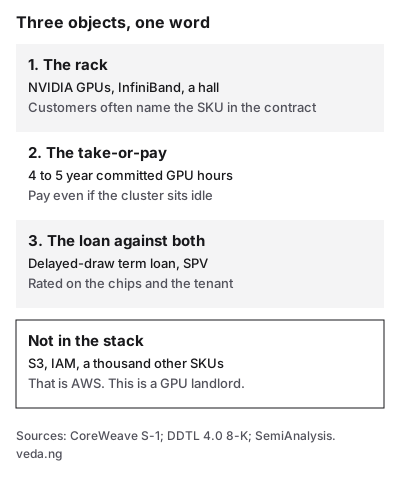
In 2024 SemiAnalysis used "neocloud" for a company that rents GPU time. Not a full cloud. No CRM suite. No giant object-storage business. GPUs, a fast network, and a bill. The four names it treated as the big ones were CoreWeave, Lambda, Crusoe, and Nebius.
AWS sells hundreds of products. GPU boxes are one line in a much bigger catalogue. A neocloud sells a rack and a contract. If the contract is take-or-pay, the customer pays whether the cluster is busy or not. If the loan is tied to that contract, the credit score that matters is the customer's, not the renter's.
"Cloud" usually means many customers, many products, and a business that can lose one account and keep going. CoreWeave's IPO filing, the later quarterly table of big customers, and the loan papers show one kind of buyer, one family of NVIDIA chips, and a company set up just to borrow the money. The loan contract is the real document. The homepage is advertising.
People then stuck the word on anything with a GPU and a press release. Three different products got mixed together.
The first product is GPU hours. CoreWeave, Lambda, Nebius, Crusoe Cloud, and IREN's Microsoft cloud deal sell reserved time on named NVIDIA chip models. CoreWeave's average signed term moved from about four years to about five.
The second product is building power. Applied Digital and Hut 8 sign 15-year pay-anyway leases of computer-room power to unnamed giant cloud companies with high credit ratings. The customer brings the chips. Equinix and Digital Realty have sold that product for years. Painting "AI" on the building does not turn it into a GPU cloud.
The third product is an inference API. Together, Fireworks, Groq, Cerebras. You buy tokens, not a rack. Those names already sit in the agent stack. Folding them into "neocloud" hides who owes the bank.
What the filings actually say
CoreWeave is a US company that rents GPUs and files an S-1, a 10-K, and 10-Qs. Nebius is also on Nasdaq. CoreWeave has the longest US paper trail, so it is the worked example, not the whole market.
Sales were $16 million in 2022, $229 million in 2023, and $1.915 billion in 2024, then $5.131 billion in 2025. The company lost $863 million in 2024 and $1.167 billion in 2025. Interest in 2025 was $1.229 billion. Adjusted EBITDA that year was $3.093 billion. Official net loss and adjusted EBITDA are not the same number. Interest is why they split.
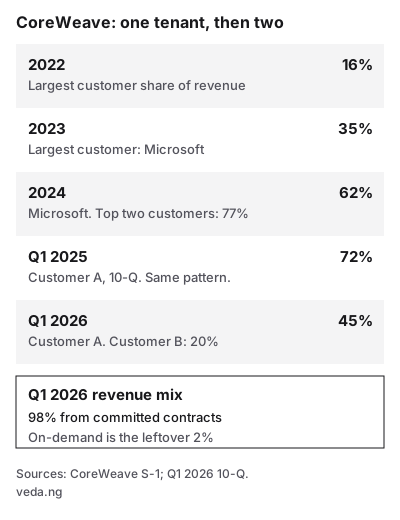
The IPO filing was plain about how much sales sat with one buyer. The largest customer was 16% of 2022, 35% of 2023, and 62% of 2024. Microsoft was that name in 2023 and 2024. The top two customers were 77% of 2024. CRN's read of the filing walks those rows and does not add new names. The Q1 2026 10-Q still will not print the names in that table. Customer A was 72% of Q1 2025 sales and 45% of Q1 2026. Customer B was 20% in Q1 2026. Signed deals, including capacity handed over before the start date, were 98% of sales in both of those quarters. Walk-up usage is the leftover.
 Tap to enlarge
The IPO filing also said current customers had "contractually specified our use of NVIDIA GPUs." The contract assumes NVIDIA. NVIDIA sells the chips, owns shares, and, in the IPO prospectus, was also a customer. CNBC and Reuters reported that NVIDIA backed the smaller IPO with a $250 million order at $40 a share. That is press, from people said to know the order. The public facts are the $40 price, $1.5 billion raised, a flat close at $40, and a company value near $23 billion if you count all shares.
Reuters also recorded the start. Atlantic Crypto was an Ethereum miner, founded in 2017. The Merge in 2022 cut mining rewards. The GPUs stayed. The bill changed.
The loan is against the customer
In August 2023 Blackstone and Magnetar led a $2.3 billion loan backed by GPUs. In May 2024 a $7.5 billion delayed-draw term loan followed. That is a loan the borrower can pull in pieces as it buys machines. Same leads, plus Coatue, Carlyle, CDPQ, DigitalBridge, BlackRock, Eldridge. On 30 March 2026 CoreWeave Compute Acquisition Co. VIII, LLC signed DDTL 4.0, an $8.5 billion facility "entered into primarily to finance capital expenditures required to perform a customer contract, including the acquisition of GPU servers." The press release called it the first high-grade rated financing "secured by HPC infrastructure and an associated customer contract." Moody's A3. DBRS Morningstar A (low). The investor-relations copy matches the 8-K exhibit. One slice of the loan floats at SOFR + 2.25%. One slice is fixed at about 5.9%. It comes due in March 2032. Blackstone Credit & Insurance anchored it.
Moody's did not rate CoreWeave the brand. It rated a company created to take this loan, the chips inside it, and one customer's promise to pay. Strip that named customer and the same racks do not get A3. "First investment-grade GPU financing" is customer credit with a lien on the chips. Nebius said the same thing in plainer English a year earlier.
Nebius wrote it into a 6-K dated 8 September 2025. Microsoft would take reserved GPU capacity in Vineland, New Jersey, over five years. Total contract value about $17.4 billion through 2031, or about $19.4 billion if Microsoft took the extras. Cash from the deal would pay for part of the machines and the hall. The rest, in the company's words, would come from "the issuance of debt secured against the contract in the near term, at terms enhanced by the credit quality of the counterparty." The customer's rating is what makes the loan cheap.
The Meta Infrastructure Services Agreement exhibit is the contract text. $12 billion of reserved five-year clusters, NVIDIA Vera Rubin, deployments from early 2027. A further order of up to $15 billion lets Meta buy unsold capacity on certain clusters if Nebius does not sell it to someone else. The 6-K is the summary. Nebius said it wants to sell that slice to other buyers first. The exhibit even talks about a setup meant to keep the loan standing if the parent company goes bust. Up to $27 billion is the ceiling. $12 billion is the reserved floor. Those are two numbers, not one $27 billion contract.
The Q1 2026 10-Q put current debt at $7.547 billion and longer-term debt at $17.312 billion. That is about $24.9 billion of debt on $55.6 billion of assets, of which property and equipment was $36.4 billion. Most of the assets are GPUs and leases.
Two different "future sales" numbers
At year-end 2024 CoreWeave had $15.1 billion of remaining performance obligations, up from $9.9 billion a year earlier. That is an official accounting term. It means signed work not yet counted as sales, and still subject to the company actually doing the work.
By 31 December 2025 the company was leading with "revenue backlog" of $66.8 billion. The footnote is the analysis. Remaining performance obligations, plus other amounts the company guesses it will later count under signed deals, in each case if it can deliver and if the service is available. By 31 March 2026 that figure was $99.4 billion. The annual-report letter said no single customer was more than 35% of backlog at year-end 2025, against 85% at the start of the year. The FY2025 10-K repeats the Platinum ClusterMAX claim and the sales series. Mix in the backlog is not mix in this quarter's sales. A new Meta or OpenAI order can shrink Microsoft's share of future work while Microsoft still pays this quarter's bill.
The IPO filing already warned that guesses about how long GPUs stay useful might be wrong, and that customers might not let the company move old chip models to someone else. Average signed term moved from about four years to about five, per the year-end letter. Plane-leasing firms have run this structure for decades. They buy the plane, attach a lease to an airline, borrow against both, and live on what the airframe is worth when the lease ends. A 737 still flies in year twelve. A training chip the lab treated as current in year one is last year's chip by year three if a newer one exists. The customer can still owe under the pay-anyway contract. The rack can still be the wrong rack. What the renter's shareholders own is whatever is left. What protects the lender is the customer's name, not the used-H100 market.
OpenAI is the other named ceiling. CoreWeave announced an agreement of up to $11.9 billion on 10 March 2025, plus $350 million of stock to OpenAI at the IPO. Reuters confirmed the size the same day. A May expansion of up to $4 billion, then a later expansion of up to $6.5 billion, brought the company's own total to "up to approximately $22.4 billion." "Up to" is a cap. It is not cash in the bank. Q1 2026 added a new $21 billion Meta commitment in March and a multi-year Anthropic agreement. Named ceilings stacked on the same books. The halls still have to be built.
On the 26 February 2026 earnings call, management said 2026 spending on machines and buildings would be at least $30 billion, more than twice 2025, to support the signed book. That is talk on a call, not a 10-K line.
Microsoft is also a customer
Microsoft still runs Azure. It also rents GPU hours from firms that borrowed against a Microsoft contract. Those hours show up as CoreWeave or IREN sales, and as a Microsoft running cost, not as Microsoft-owned servers on this quarter's books. The company has not published a memo that says why. The public record is the contracts themselves. CoreWeave. Nebius in Vineland. IREN in Childress. Press has also tied Microsoft to Nscale's Portugal site. That last tie is reported, not a 10-K line.
NVIDIA already sits on more than one side of CoreWeave. It sells the chips, owns shares, and, in the IPO prospectus, was a customer. The renter needs chips. The lender needs the customer to pay. NVIDIA needs both to keep buying. Those roles can clash.
On 3 November 2025 IREN said it had signed a five-year GPU cloud contract with Microsoft of about $9.7 billion, including a 20% prepayment, and a Dell equipment order of about $5.8 billion. On 13 August 2026 it said Horizon 1, the first of four 50 MW liquid-cooled phases at Childress, Texas, had been delivered and accepted. Acceptance starts the service term. The other three phases are still a schedule. A signed ceiling is not a live hall. IREN later said it had signed $2.8 billion of extra multi-year AI cloud contracts and lifted a 2026 AI-cloud annual run-rate target above $4 billion. That is a company target, not counted sales.
The private names repeat the same three objects without an IPO filing. Lambda said it raised over $1.5 billion Series E in November 2025. Forge puts the round at $5.9 billion after the new money. There is no S-1. Sacra's sales guesses are a research house's model. The raise is the public number. Crusoe closed an initial $1.375 billion Series E in October 2025 at a value above $10 billion, with NVIDIA in the list. The Abilene construction loan already sits in the debt essay. Nscale was reported in March 2026 at a $14.6 billion value after a $2 billion Series C, with a Portugal build tied to Microsoft. That is a magazine's round-up. Same ingredients. Not a 10-K.
Miners and GPU renters are not the same product
Bitcoin miners already had a place in the grid queue and cheap power. When mining pay fell and H100 rents rose, they used the same sites for GPU halls.
Hut 8's Nueces County, Texas campus is now a 15-year, $9.8 billion lease for 352 MW of computer-room power, the second phase with the same unnamed high-grade customer. Reuters covered the first 352 MW pay-anyway deal in May. The July follow-on takes the site to 704 MW and $19.6 billion of rent over the first lease period. First halls for phase 2 are expected in Q2 2028. Applied Digital's Delta Forge 2 lease is 210 MW, 15 years, about $5.2 billion over the first period, third deal with the same unnamed giant cloud company. An April lease at Delta Forge 1 was $7.5 billion for 300 MW. Applied Digital said the signed portfolio was 1.4 GW of computer-room power and about $36 billion of first-period rent.
Those numbers are large. They are not GPU-hour sales. A 15-year power lease is a building product. A 5-year GPU pay-anyway deal is a chip product. Analysts file both under neocloud because both used to mine bitcoin. How the asset wears out, what it is worth later, and whether you can swap in a new chip are different. A hall can host the next chip model. A financed H100 cluster cannot, not without another loan.
Power is scarce either way. CoreWeave said it had more than 850 MW of live power at year-end 2025 and about 3.1 GW contracted. The Q1 2026 release said live power had passed 1 GW. IREN's February filing described 810 MW of running data centres and more than 4.5 GW of secured power, with an AI cloud target of 480 MW in 2026. The wait for a grid hookup, transformers, and liquid cooling set the clock. NVIDIA can ship a chip model faster than a utility can turn on a power line.
SemiAnalysis ClusterMAX is the industry's own scorecard for whether a cluster actually trains. CoreWeave says it is the only Platinum in the 2025 ranking. That is a claim about the network inside the hall, not a claim about who pays the loan. A Platinum cluster with one customer is still one customer.
The first lease that ends
The A3, the backlog, and the homepage treat three separate conditions as one story. The hall has to exist. The customer has to pay. The rack has to be worth something when the term ends.
The hall has to exist on the date in the contract. CoreWeave's 2026 spend guidance of at least $30 billion is the delivery bill. IREN's three phases still on a schedule are the same risk in public. "Up to" becomes real when the cluster is accepted, not when the press release hits.
The customer has to pay. That is Microsoft, Meta, or OpenAI credit, wrapped in a company created to take the loan. CoreWeave the equity is what is left after that structure. Interest already ate $1.229 billion in 2025. Adjusted EBITDA of $3.093 billion is the line that ignores that bill.
The rack has to be worth something when the term ends, or the pay-anyway contract has to cover the debt even if nobody wants that chip model. Backlog mix can look spread out while this quarter's invoice is still one name. A government counting GPUs should not add CoreWeave's 850 MW to a national scoreboard. That is a private lease, not national compute.
The IPO year is already on the tape. The year that tests the structure is the first time a five-year pay-anyway deal ends on a GPU generation the lab no longer wants, and the loan company still owes Blackstone. Until that happens, the homepage still says cloud. The loan papers already put the risk on the customer.